Service · AI visibility
AI visibility tracking
See how AI platforms actually talk about your brand: which questions mention you, which sources the answers lean on, and how that picture shifts between providers, topics and dates.
See the dashboard in action
Four views from the product: compare share of voice, see how AI platforms differ, inspect the sources answers cite, and review how answers frame your brand.
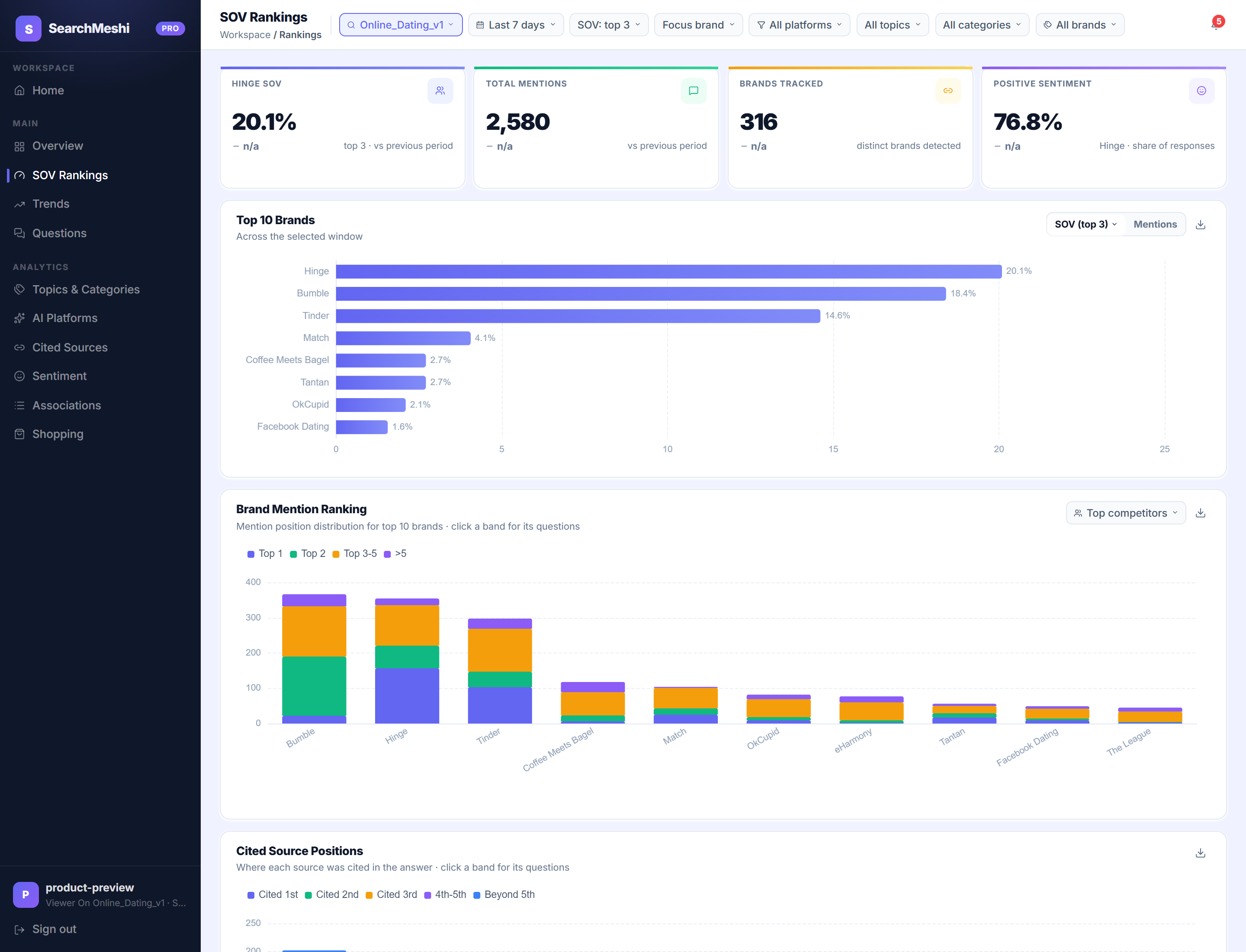
What you can explore
- Mention tracking across a question set chosen for your market — not a generic keyword list.
- Cited-source analysis: which domains and URLs the answers lean on, and how that mix moves.
- Provider and topic comparisons, so you can see where coverage differs between platforms.
- Trend views over time and competitor views, so every movement has context.
What your team gets
A standing view of your AI presence: share-of-answer style comparisons and the mentions and citations behind them. Mentions describe brands named in answers. Citations describe the sources linked by those answers. The two are reported as distinct signals, because they call for different work.
Competitor views sit beside your own numbers, so a gain or a loss is always read relative to the field — never as an isolated figure.
How an engagement runs
- 1
Define the question set
We agree the questions that matter — the ones your buyers actually ask — and configure the project around them.
- 2
Read mentions and citations
The dashboard records how answers name brands and which sources they link, so presence and evidence are visible separately.
- 3
Compare and act
Provider, topic and competitor views turn movement into decisions: where to defend, where to build, where to ask why.
Questions people ask
Which AI platforms are covered?
Coverage depends on the tracked question set we configure together. The walkthrough shows exactly which providers your project includes — we do not promise universal platform coverage.
How is this different from rank tracking?
Rank trackers measure positions in link lists. AI visibility measures whether generated answers name you, cite you — or cite a competitor instead.
Can we compare competitors?
Yes. Competitor views show how other brands fare on the same questions, so gains and losses are relative rather than absolute.